Early life and education
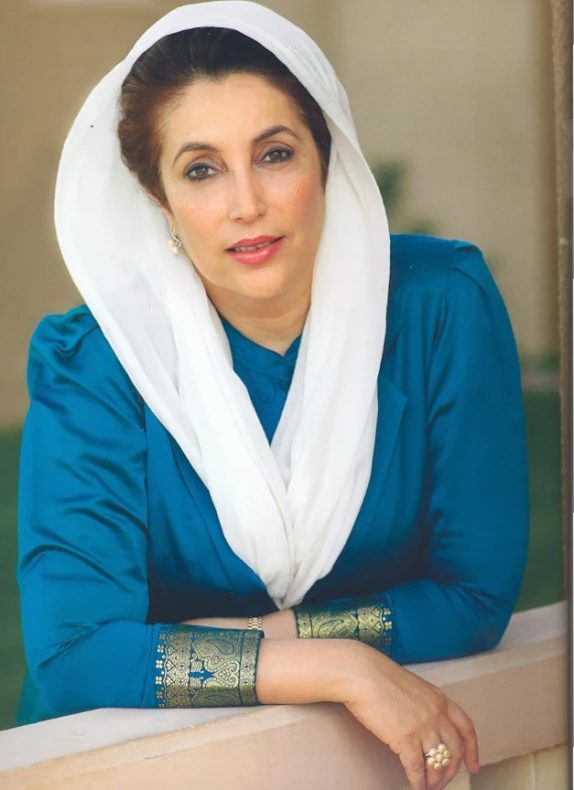
Benazir Bhutto was born in 1953 in Karachi, Pakistan, to Zulfikar Ali Bhutto and Begum Nusrat Ispahani, the eldest of four siblings. As a young girl she was exposed to political ideas and policies by her father, the former prime minister of Pakistan, and would one day follow in his footsteps.
She completed her early education in Pakistan and attended Radcliffe College, graduating cum laude from Harvard University in 1973 with a bachelor's degree in comparative government. She received another undergraduate degree in philosophy, politics and economics from Lady Margaret Hall, Oxford, in 1977. During her time there she became the first Asian woman to be elected president of the Oxford Union.
Imprisonment, exile and opposition
Upon her return to Pakistan in 1977, she and her family were placed under house arrest following the removal of her father as prime minister and the emergence of General Mohammad Zia ul-Haq. She inherited the leadership of her father's political party, the Pakistan People's Party (PPP), and spent the next two years organising rallies to force General Zia to drop murder charges against her father.
Against local pleas and international pressure, Zulfikar Ali Bhutto was hanged in April 1979. Soon afterwards she was arrested and taken to Larkana Central Jail; in 1981 she was imprisoned in Sindh Province. Succumbing to immense international pressure, she and her family were allowed to travel abroad in 1984 for medical aid. Following her recovery she resumed her political work, becoming a leader in exile for the PPP and raising awareness of the condition of political prisoners and human rights violations under the Zia regime.
In 1982, three years after the military coup and her father's execution, the 29-year-old Bhutto became chairperson of the PPP — the first woman in Pakistan to head a major political party. In 1986 she returned to Pakistan after two years of self-exile, following the lifting of martial law, and launched a nationwide campaign for open elections.
Prime minister, 1988–1990
In 1988 a mysterious aviation accident caused the death of General Zia, leaving a vacuum in Pakistani politics and the need for elections. On 16 November 1988, in the first open election in more than a decade, the PPP won and Bhutto became prime minister. At 35 she was one of the youngest chiefs of state in the world — and the first woman ever to serve as prime minister of an Islamic country. She remains Pakistan's only female prime minister.
Noted for her charismatic authority and political astuteness, Bhutto drove initiatives for Pakistan's economy and national security and implemented capitalist policies for industrial development and growth. Her political philosophy and economic policies emphasised deregulation, particularly of the financial sector, flexible labour markets, the denationalisation of state-owned corporations and the withdrawal of subsidies. She released political prisoners and took steps to restore fundamental human rights. She was concerned with women's social and health issues, including discrimination against women, and demonstrated considerable skill in winning international diplomatic and economic support for Pakistan.
Her popularity waned amid recession, corruption and high unemployment, which led to the dismissal of her government by the conservative president Ghulam Ishaq Khan in 1990.
A second term, 1993–1996
In 1993 Bhutto was elected for a second term after parliamentary elections, serving from 19 October 1993 to 5 November 1996. She survived an attempted coup d'état in 1995. Her hard line against the trade unions and tough rhetorical opposition to her domestic political rivals and to neighbouring India earned her the nickname "Iron Lady"; she was also respectfully referred to as "BB".
In 1996, charges of alleged corruption were levelled against her, which led to the final dismissal of her government by President Farooq Leghari. Bhutto conceded her defeat in the 1997 parliamentary elections and went into exile in Dubai in 1999.
Return and assassination
Nine years later, in 2007, she returned to Pakistan, having reached an understanding with President General Pervez Musharraf, who granted her amnesty and withdrew all corruption charges against her. Bhutto was assassinated in a bombing on 27 December 2007, after leaving the PPP's last rally in Rawalpindi — two weeks before the scheduled 2008 general election in which she was the leading candidate. Her party subsequently won the elections on a wave of sympathy generated by her assassination.
The legacy
Bhutto's achievements in office included initiatives for healthcare, rural electricity, schools and women's rights. The organization that carries her name exists to continue that work where it is most needed: in communities still waiting for safe water, a functioning clinic, a classroom, or a reliable source of power.
Her life is also a record of the cost of political courage. The archive preserves it without hagiography: the achievements, the controversies, the imprisonment, the exile, and the violence that ended her life.